
100,000 CVEs in 2026: Notes on long term software maintenance.
CVE publications rose roughly 15X between 2016 and 2026. Keeping up requires a fresh approach to software maintenance.
On November 13, 2026, The Register reported that VulnCheck had counted 100,222 published CVEs this year.
AI agents have made finding and exploiting software vulnerabilities easier than ever before.
On the other hand, counterintuitively, overall enterprise vulnerability fix times have actually gotten slower in many environments. According to the Verizon 2026 Data Breach Investigations Report, the median time to fully remediate a known exploited vulnerability rose to 43 days, up from 32 days the previous year. Furthermore, only 26% of vulnerabilities in CISA's Known Exploited Vulnerabilities (KEV) catalog were fully fixed, down from 38%.
While both attackers and defenders are using coding agents, "Mean Time To Resolve"(MTTR) for bugs has not kept pace because fix design, verification and review still takes a significant amount of time.
Put simply, human bandwidth is limited. Rolling out a patch and getting it onto customer systems has never been easy and not much has changed in that space.
The engineering requirement is harder than finding more bugs: the capacity to deliver validated fixes must keep pace with the arrival of actionable reports. Otherwise, faster discovery produces a longer queue of known exposure.
The decade behind the headline
The CVE Program's published-record metrics show 6,457 publications in 2016 and 100K+ in 2026, roughly 15 times as many.
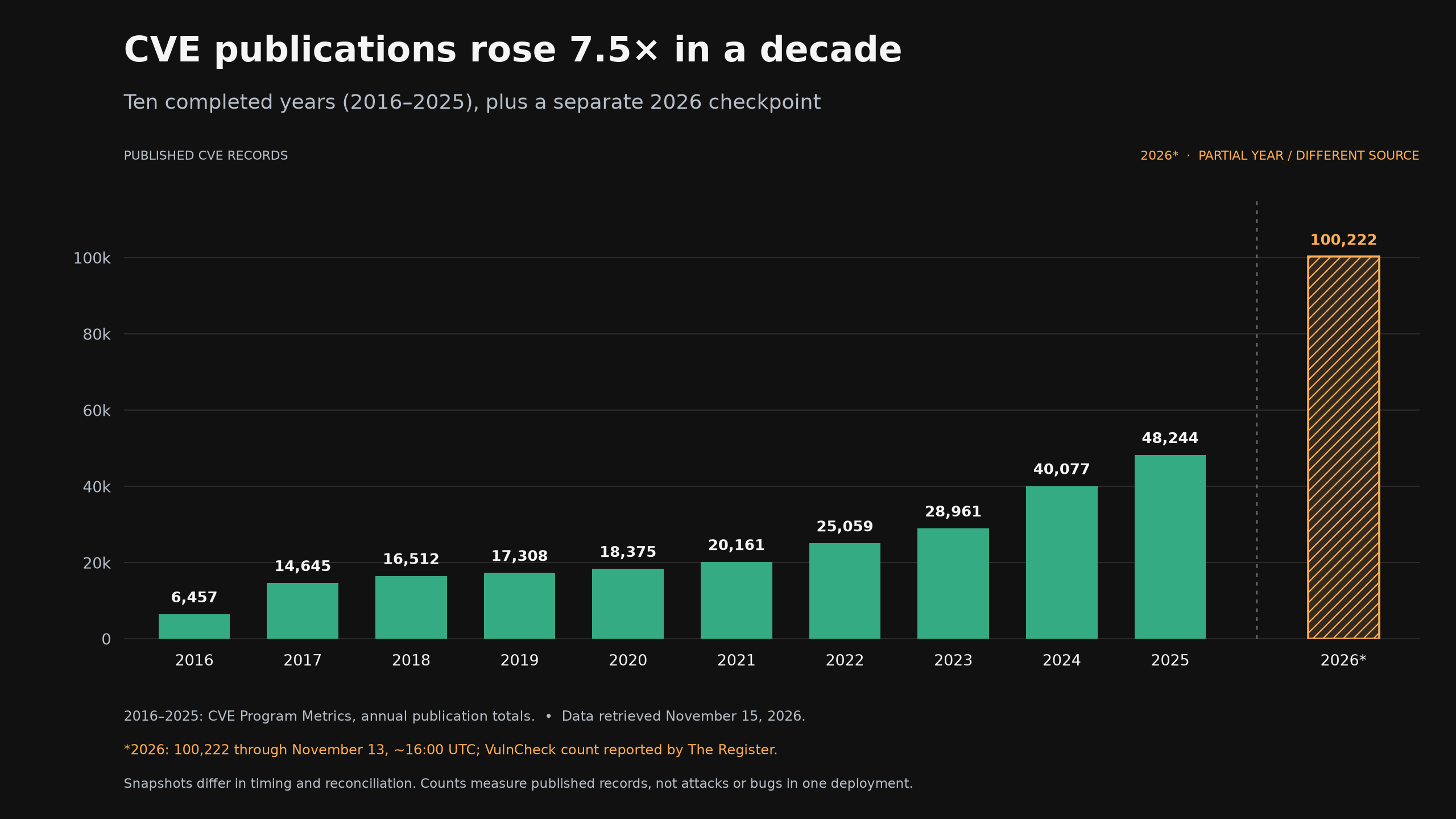
| Publication year | Published CVE records |
|---|---|
| 2016 | 6,457 |
| 2017 | 14,645 |
| 2018 | 16,512 |
| 2019 | 17,308 |
| 2020 | 18,375 |
| 2021 | 20,161 |
| 2022 | 25,059 |
| 2023 | 28,961 |
| 2024 | 40,077 |
| 2025 | 48,244 |
| 2026 through November 13, approximately 16:00 UTC | 100,222* |
Sources: 2016–2025, CVE Program Metrics; 2026 checkpoint, VulnCheck's count reported by The Register.
Bugs are a bigger problem now
Not all CVEs are exploitable and need to be resolved instantly. Evidence of exploitation matters; CISA recommends using its Known Exploited Vulnerabilities catalog in prioritization.
Once prioritization, the bug input and remediation output queues still have to balance. If actionable work arrives faster than a team can validate and deploy repairs, the backlog grows. CVEs often arrive in bursts arrives and the resolution of medium priority bugs keeps slipping.
To understand the scope of the problem for the project you are working on, measuring various phases of this process will help.
Measure report-to-validation time, reviewer waiting time, and patch-to-deployment time separately. A PR created in five minutes says little if validation and review take four days and rollout takes another week.
Mean time to verify: who reviews all those fixes?
Generating patches faster moves work into the verification and review queue.
Automate the checks that have explicit outcomes: compilation, type checking, focused regression tests, and relevant static analysis. Use agent reviewers to look for missing cases and challenge the proposed cause. Give human reviewers the decisions that need ownership: changed behavior, security boundaries, compatibility, and acceptable rollout risk.
The handoff should contain enough evidence to avoid repeating the investigation:
- The report, affected versions, and conditions needed to trigger the failure.
- The suspected cause, rejected explanations, and supporting observations.
- The baseline revision, proposed patch, and exact environment needed to reproduce it.
- Commands, assertions, before-and-after results, and checks that could not run.
- Review decisions, remaining uncertainty, and deployment or recovery constraints.
A chat transcript helps explain how someone arrived at a decision.
It is a poor substitute for an indexed record that points to the exact artifacts behind that decision. A reviewer should be able to rerun the reproduction without borrowing the author's laptop.
Test the bug, then the repair
Testing on a developer's machine has its place. The problem is evidence that depends on unrecorded local state: an uncommitted file, a different dependency, a script or credentials nobody else has.
Automated bugfixing needs a repeatable environment and a test that distinguishes the broken behavior from the repaired behavior.
Consider a hypothetical authorization bug: tenant A can retrieve tenant B's invoice. The regression test must show that access succeeds incorrectly on the vulnerable baseline, then is denied after the patch. It must also show that tenant B can still retrieve its own invoice. A fix that returns an error for every request can pass a badly written security test.
Do not trust an agent-generated fix because it comes with agent-generated tests. Inspect the assertions, confirm the baseline fails for the expected reason, and keep independent checks the patch author cannot silently weaken.
Preserve the test, validation environment (preferably in a sandbox), and results alongside the patch itself. Record retention periods and access rules; an investigation can contain customer data and security-sensitive details.
FixBugs' validation workflow makes the before-and-after distinction explicit. It can generate a focused Reproduction and run it against the baseline and candidate Fix. The validation environment, commands and artifacts are preserved for future perusal.
Its review workflow combines security checks with agent review, and the team reviews and merges.
A released patch starts another clock
A patch exposes information about what exactly was wrong. Comparing vulnerable and repaired builds can narrow an attacker's search; Google Project Zero has documented patch diffing directly. Customers on the vulnerable version remain exposed even though the patch is available via an update.
The delay can sit upstream of the customer. Project Zero's Mali driver investigation described fixes available from ARM while affected downstream devices remained vulnerable. A customer cannot install an update their device vendor has not delivered.
Security updates should be minimally intrusive and automatic by default within a defined operating policy. CISA's Secure by Design pledge asks manufacturers to improve patch installation and support automatic updates.
Make upgrades less disruptive
Hitless upgrades and restarts aim to replace a process without interrupting service. The challenge is handling changes in code, protocols, and state. If you do not control both the client and the service, you face further challenges.
| Mechanism | What it helps preserve | Limit to account for |
|---|---|---|
| Hot restart and connection draining | An old process finishes existing work while a replacement accepts new work. | Long-lived connections may keep draining stuck. |
| Rolling or blue-green upgrade | Service availability while instances change version. | Old and new versions must agree on schemas and protocols; spare capacity is needed. |
| In-memory hotpatch | A running process receives a supported security change without restarting. | Not every change may be eligible |
| State-preserving kernel replacement | Selected system calls provide uninterrupted service while the kernel updates. | Third party code and drivers may not support it. |
Envoy's hot restart is a concrete example: existing connections remain with the old process rather than transferring into the replacement. Draining reduces disruption; persistent connections may be disrupted.
Windows Server Hotpatch updates in-memory code for supported security updates. Periodic baselines still require restarts, and an urgent update can require an unplanned baseline. Its documented recovery/rollback procedure still requires a reboot.
The Linux 6.19 documentation describes Live Update Orchestrator. It coordinates a kernel replacement through kexec, preserving selected resources across the transition. This goes beyond patching a function in place.
Design for continuous repair
Our expectation is that frequent security repair will become an architectural constraint, alongside availability and latency.