
Building AI SRE In-House: Costs and Tradeoffs to Consider
What engineering leaders should model before committing to build, operate, and continuously improve AI SRE in-house.
Every engineering organization that sees the potential of AI SRE eventually asks the same question:
Why don't we build it ourselves?
It is a fair question. Most engineering teams have capable developers, access to modern models, and experience building production software. A working prototype can also appear surprisingly quickly.
But technical capability is only the start of the decision. The real question is whether your organization is prepared to own everything that comes after the prototype.
It's worth keeping in mind that running and maintaining AI SRE software is a long-term commitment rather than a short engineering project.
What building AI SRE in-house really means
AI SRE is not just a model connected to logs. A production capability must retrieve telemetry, reason across incidents, be deployment aware, know about your codebase, coordinate workflows, respect permissions, record decisions, and fit the systems engineers already use.
Building it in-house means owning three categories of work:
- Product development: the core analysis system, observability and incident integrations, orchestration, interfaces, and internal enablement.
- Operations: model and infrastructure usage, monitoring, telemetry access, security, uptime, latency, and reliability ownership.
- Continuous improvement: evaluation, regression testing, prompt and workflow updates, model upgrades, governance, and maintenance as tools and APIs change.
The first release is one milestone inside that lifecycle. It is not the finish line.
A working demo is not a production AI SRE system
A demo can prove that a model can summarize an alert or suggest a likely cause. Production AI SRE must behave predictably when telemetry is incomplete, services are degraded, permissions differ, or a model changes underneath the workflow.
That requires authentication, audit trails, evaluation pipelines, deployment controls, rollback strategies, monitoring, security review, and operational support. It may also require AI, backend, frontend, platform, DevOps, QA, security, and product expertise.
The system must integrate with logs, metrics, traces, deployments, CI/CD pipelines, incident tools, source control, internal knowledge, and governance processes. At that point, the organization is not building a feature. It is building another production product that needs an owner and a roadmap.
The hidden costs: time, infrastructure, and maintenance
Time is easy to underestimate. A prototype may take weeks, while a reliable AI SRE system can take months to integrate, harden, evaluate, and roll out. During that period, the same engineers are not working on customer-facing priorities.
Infrastructure expands with adoption. More investigations mean more token consumption, inference, telemetry retrieval, embeddings, storage, caching, monitoring, and scaling. Costs move with usage and with the volume of context each investigation requires.
Maintenance is the cost that never becomes zero. Models evolve, APIs change, prompts need refinement, and new failure modes appear. Every change needs evaluation, and every production workflow needs reliability discipline.
The permanent Build -> Operate -> Improve cycle
Every in-house AI SRE capability enters three permanent stages:
- Build: create the system and integrate it with the engineering environment.
- Operate: keep it secure, observable, resilient, and cost-efficient in production.
- Improve: evaluate quality, refine workflows, adopt better models, and respond to changing systems and business needs.
These stages overlap. A team does not stop operating while it improves the system, and it does not stop building when a model or integration changes.
Make the economics visible
A useful Build vs. Buy comparison replaces generic assumptions with your engineering headcount, delivery timeline, hourly cost, infrastructure spend, platform fees, and ongoing operating effort.
Adopting a platform does not remove cost. It changes how cost and responsibility are distributed. The provider funds shared infrastructure, evaluation methods, telemetry tooling, and operational improvements, while the internal team focuses on integration, governance, and adoption.
Use the model below to compare both ownership paths under the same assumptions.
Compare year-one AI SRE ownership paths
Replace the example assumptions with your team, infrastructure, and platform numbers.
View cost breakdown
- Product development
- $384,000
- Operate
- $192,000
- Improve
- $96,000
- Platform fee
- $120,000
- Implementation
- $32,000
- Governance
- $28,800
This directional model uses year-one estimates. Replace every default with your own cost data before using the comparison in a business case.
An illustrative year-one comparison
With the default assumptions in the calculator, the model estimates:
- Internal ownership: $672,000
- Platform adoption: $180,800
- Absolute year-one difference: $491,200
- Engineering-hour difference: 5,152 hours
Those figures are directional, not universal benchmarks. Under these defaults, the platform path has the lower estimate. Different team costs, timelines, infrastructure requirements, or platform fees can reverse the result.
The value of the model is not the default answer. It is the ability to expose the assumptions behind the answer.
So, should you build or buy?
Building internally can be justified when AI SRE is strategic intellectual property, creates a distinct competitive advantage, and has a dedicated team prepared to own it for years.
Before committing, ask five questions:
- Will an internal AI SRE capability create a unique advantage for the business?
- Do we have a dedicated team to operate and improve it over the long term?
- Can we justify the full lifecycle cost rather than only the prototype budget?
- Which customer or product priorities will be delayed while this team builds infrastructure?
- Are we solving a differentiated product problem or recreating a capability available from a platform?
Platform adoption can be the stronger choice when the objective is to investigate incidents faster, recover engineering capacity, and reach production without creating another internal service to maintain. The organization still owns integration, governance, rollout, and vendor management, but it does not fund every layer alone.
Neither path is automatically correct. The decision depends on where your organization creates differentiated value and which responsibilities it is equipped to carry.
The decision is economic, not just technical
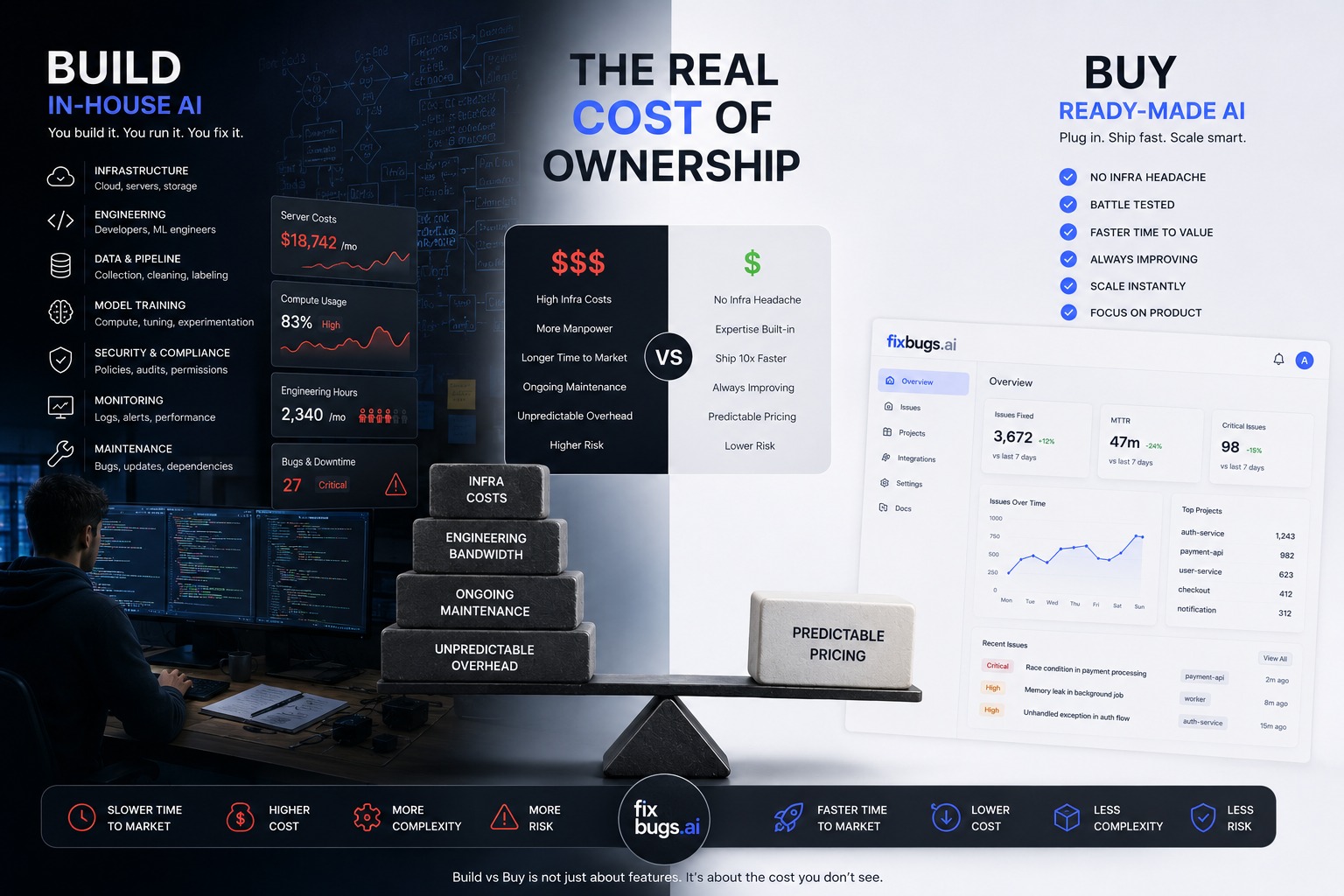
Your team may be fully capable of building AI SRE in-house. Capability does not establish that the investment is the best use of engineering time.
The decision is a capital-allocation choice: fund the people, infrastructure, reliability, and continuous improvement internally, or adopt a platform and concentrate ownership on integration and governance.
Model the full year-one cost. Account for the permanent Build -> Operate -> Improve cycle. Then compare that investment with the customer and product value the same engineers could create elsewhere.
That is how an AI SRE architecture choice becomes a defensible business decision.